Thursday, July 13, 2017

Reading Pride and Prejudice with an Adult Brain

(Note: I’m going to assume that you’ve read Pride and Prejudice. If you haven’t, go do it. I’ll wait.)

Our brains don’t stop developing when we turn eighteen. The rest of our bodies have mainly matured to adulthood by then, but our brains don’t reach adulthood until we are twenty five or so. I thought of that a lot when I first started rereading Pride and Prejudice. The last time I read it, I had an adolescent brain.

It has been twenty six years since I last read Pride and Prejudice, and I find myself constantly wondering as I read it again, “What could I possibly have gotten out of this last time I read this? I was such a child.” I’m sure I got a lot out of it, but it feels like I must have been deaf to a lot that Austen does in the novel. It’s the old puzzle of when we finally arrive and become our true selves. It feels like we are now our true selves, but in ten years, or twenty six, we will look back and think that we were babes in the woods, complete innocents who were incapable of deeply understanding complex issues and layered works of literature.

Monday, February 6, 2017

Political Act of an Introvert

Donald J. Trump has been President of the United States for a little over two weeks now, and I’m still struggling with how I should respond to that news. On Election Night, when it became clear what we had elected, I lost sleep trying to figure out an appropriate response. I thought of contributing money to different causes, like the Southern Poverty Law Center, or Planned Parenthood. I thought of supporting the free press by getting a subscription to the New York Times, or the Washington Post. I haven’t done either of those things yet, but the Trump presidency is still young. I’m keeping my powder dry.

I didn’t think at all about participating in any marches or protests, but that’s the first thing that I’ve actually committed to do. I’ll be marching on April 22nd, which is also Earth Day, as part of the March for Science.

Tuesday, March 1, 2016

Pigs, Fools, and Socrates: "Ruined by Reading: A Life in Books" - Lynne Sharon Schwartz

This year, I’m trying to be more intentional in engaging people about the books we’re reading. I’m asking for reading recommendations, and joining them in conversation about makes a book enjoyable enough to want to share it with others. My goal is to read, deeply and attentively, fifty book recommendations while in my 50’s. (It would be wonderful if I could read fifty in one year, but that seems unlikely, given the realities and demands of life right now.) Even though this book wasn’t one of the books that a friend recommended, it made a perfect work to read early in the “50 at 50 Project”, as I’ve come to think of it.

Actually, I don’t recall how this book came to be on my reading list, but it has been there a long time. Maybe someone really did recommend it to me, and I’ve forgotten the details. Perhaps I came across it on the shelves of a bookstore back in the late 90’s, though it doesn’t seem like a book that would have spent much time in stores, to be honest. It seems like the kind of book with a limited appeal, but many small, beautiful things don’t catch the attention and imagination of the masses.

Thursday, February 11, 2016

Not Your Father's Poetry - Nine Horses, by Billy Collins

If you have the common misconception that poetry is only for eggheads, that it is impossibly complex, and that it has nothing to say to you, have I got the poet for you. Meet Billy Collins, who writes some of the most engaging and accessible poetry being written today.

If you have the common misconception that poetry, if paired with the adjective “accessible”, is inane, sing-song, and shallow, have I got the poet for you. Meet Billy Collins, former U.S. Poet Laureate, Distinguished Professor of English at Lehman College, and winner of dozens of awards and honors for his work. His poetry has been included in the Advanced Placement examinations given to high school students annually, marking it as culturally and academically significant.

Wednesday, February 10, 2016

The Democracy of Reading

There couldn’t have been a better book to begin my 50 at 50 Project, where I read fifty books recommended to me by fifty different people, than The Guernsey Literary and Potato Peel Pie Society, by Mary Ann Shaffer and Annie Barrows. My goals for the 50 at 50 Project are to read books that I wouldn’t have otherwise, and to engage people in a conversation about books that they enjoy, and both of these goals are major themes in TGLAPPPS.

My wife and I met at a book group, which started as a group of people talking almost exclusively about books, and grew to incorporate more social elements, including food and friendship. Reading and talking about challenging books was a great way to get past the small talk and really know how and what people thought. In fact, we got to know each other very deeply, but skipped right past some of the biographical details that often seem essential. One person had been attending the group for over a year before we ever learned that she had a daughter. I remember telling people, after I’d been a part of the group for a couple of years, “I don’t even know for sure how many children John has, but I know what he would say in response to this passage from Nietzsche.”

Thursday, June 25, 2015

Aging with Lear

By my best estimate, I’ve read King Lear six or seven times. I read it for the first time in my early twenties, before I married and had children, and my assessment of Lear at that time in my life was that of a young man who hadn’t been forced to look hard at himself and his weaknesses. I didn’t see what Lear and I had in common, though with my latest reading, certain uncomfortable aspects of Lear’s personality resonated in a way that they didn’t twenty-plus years ago.

In my first reading of King Lear, I took Lear’s defense of himself at face value. Lear exclaims in the middle of the play, “I am a man / more sinned against than sinning.” (Act 3, Scene 2, lines 59-60). By this point in the play, Lear’s two older daughters, despite their proclamations of love in the first scene, have shown their teeth, and have driven their father and his handful of followers out into a storm with no shelter. Lear’s famous line from the middle of the storm sounds defensive. He’s willing to admit on some level that he has sinned, but his failings are not as great as the failings of others.

Friday, January 2, 2015

Tolstoy, Beethoven, and Why I Write about What I Read

I think I’ve read Tolstoy's “The Kreutzer Sonata” before, but I have only the vaguest memory of the arc of the story. In fact, I’m about halfway through a second reading, and I’m amazed and ashamed at how little it resonates with me at all. I’ve been at it for a few days, and still haven’t gotten to the part of the story that I would have described a week ago if I’d been called upon to describe the story. A week ago, I would have summarized the story by saying that a married man gets jealous when his wife plays Beethoven’s Kreutzer Sonata (a piece for violin and piano) with someone else, and that the man’s jealousy is unfounded.

Monday, May 26, 2014

“I will ask the Father, and he will give you another Advocate…” John 14:15-21

The Lectionary text for this past week was from Jesus’ last, long conversation with his disciples, as recorded in John. If you’re reading along in a red-letter version, John nearly runs out of red ink in Chapters 14-17, where we have the longest speech of Jesus recorded in the Gospels.

The emphasis on the Paraclete, translated as Advocate in the New Revised Standard Version that I prefer, brought me back to my confirmation class days. I was raised in the Missouri Synod Lutheran Church, but moved to a Baptist church when I married. It’s interesting to me how the two traditions differ in their approach to the Trinity.

In my formative years spent among the Lutherans, we made more of an emphasis on the concept of the Trinity. This is not to say that the Baptists ignore the idea, but the Lutherans felt compelled to articulate the distinctions between the Persons of the Trinity, and identify the work that each of the parts of the Godhead performed or performs.

Friday, March 14, 2014

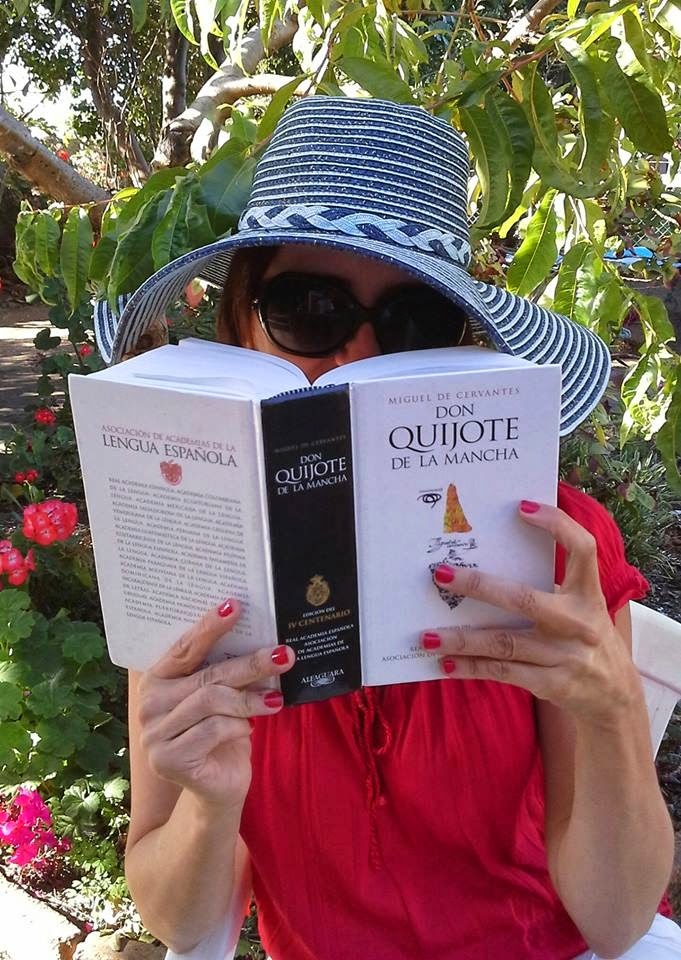
Tilting at Windmills: My Quixotic Quest

Several years ago, never mind how many, I came across an academic who claimed that Don Quixote was one of the few works that really stood up to multiple readings throughout life. In fact, the scholar claimed that Don Quixote required multiple readings. Specifically, he recommended that everyone read Don Quixote at least three times, once as a young adult, once in middle age, and once in old age.

I’ve thought a lot about this recommendation in the intervening years. In fact, the idea of books that warrant and reward multiple readings has shaped the way I think about literature, and I’ve created my own short list of books that could reward multiple readings every twenty years or so. I’ve identified six works that I found especially meaningful and rewarding when I first read them in my twenties. Those six are the Bible, “Oedipus Rex”, “King Lear”, Don Quixote, Moby Dick, and The Brothers Karamazov. Now, as I approach the end of my forties, I find myself revisiting that list, and rereading works that I read in my twenties. I have a couple of years left in my 40’s, and a couple more works to finish: Don Quixote and The Brothers Karamazov.

So, for the next several weeks, I’ll be spending time with Don Quixote, as part of my Quixotic quest to revisit some rewarding literature, and to live like literature can have an impact on one’s life.

Friday, January 24, 2014

Meditation 101: 1 Book, 1 App, and Listening to Myself Breathe

I have a friend who has been talking to me about meditation for several years now. He’s a practicing Buddhist, and leads a meditation session every week at a local Buddhist center. I have attended several times, though not regularly enough to have seen any benefits from the practice of meditation. He leads a meditation service that is also a religious service, and I have sometimes felt awkward, not really knowing how fully to participate. I’ve felt that there could be some benefit to regular meditation, but I don’t know how, or whether, to participate during the prayers which are offered before and after each twenty minute meditation period. I also know myself well enough to realize that I don’t have the fortitude to press ahead with the practice of meditation alone, without some kind of direction.

That has been the state of things for several years. I might attend a meditation service three or four times a year, and come away with the same questions and hesitations about the practice, at the same time seeing that it could be a very fruitful, centering experience.

Monday, January 20, 2014

Chocolate and Meditation

You know those times in your life, when you encounter some new word or idea, and then you just can’t seem to escape it? Me too.

A couple of years ago, I added the book Mindfulness: An Eight-Week Plan for Finding Peace in a Frantic World, by Mark Williams and Danny Penman to my reading list. I don’t even remember how I encountered it initially. (It was probably NPR, but I don’t see any reference to the book on their website. Science Friday, perhaps? Anyway…)

So, the title has been sitting on my list for a couple of years, and I finally decided that it was time to check it out. There’s been a convergence of the subject of meditation popping up in my life, and this seemed like an appropriate book to use to help get myself more grounded.

Monday, December 2, 2013

Beautiful Dystopia: The Giver, by Lois Lowry

I read The Giver, by Lois Lowry sometime back in the 90’s, and again just this week, and my perception and appreciation of the book have definitely changed. Perhaps it’s just age, and experience. Sometimes I feel like I’ve lived most of my life in a fog. I wish I’d kept notes about my initial reaction to the book. What kept me from enjoying it last time the way that I did this time? If I wasn’t old enough to really appreciate it in the 90’s, how can young adults appreciate it? I’m sure there are plenty of thoughtful, sensitive young adults who can appreciate a book like The Giver, but I apparently wasn’t one of them.

Friday, November 29, 2013

The Redemption of Sara Louise Bradshaw: Jacob Have I Loved, by Katherine Paterson

At this time of the year, I often find myself drawn to children’s books, or young adult books, probably for multiple reasons. I often feel that I have challenged myself in the books I’ve read during the rest of the year, and I’m looking for something a little less demanding. Perhaps in the chaos of the holiday season, I need something short and simple. There’s another reason I gravitate toward Newbery Award winners when the weather turns cold, to be honest. I’m also looking for books that I can read quickly, so I can boost the number of books that I’ve read during the year.

Monday, November 25, 2013

Isn't It Good...Norwegian Folktales

A book of Norwegian fairy tales, East of the Sun and West of the Moon and Other Tales, was mentioned in The Paideia Program by Mortimer Adler, which is how I first became aware of it. I found my way to The Paideia Program through reading most of what I could by Adler back in the 1980’s, and became infatuated with his proposal for reforming education long before I had children of my own.

East of the Sun and West of the Moon and Other Tales is a collection of folk tales, gathered by P.C. Asbjornsen and Jorben E. Moe, who were the Norwegian Brothers Grimm, apparently, as they collected folk tales from Norway, and put what were mainly oral stories into a written form. Some of the stories are very familiar, but some are very unusual. As a good Midwestern boy of German heritage, my fairy tales tended to be straight out of the Brothers Grimm, so this was the first time I’d heard some of these Norwegian tales.

Friday, November 22, 2013

Why I Can't Like the Ginger Man

I tried. Really, I did. I tried to like the Ginger Man, both the book by J.P. Donleavy, and the main character, Sebastian Dangerfield, but it is just not possible for me.

Early in the book, we get to see Dangerfield at his worst. His relationship with his wife and child is neglectful at best, and abusive at worst. In fact, the abuse is extravagant, both physically and emotionally.

We aren’t given much of a honeymoon period with Dangerfield. Early in the book, we are exposed to the worst of his character. Here’s a passage from page 21, when his wife returns from a trip out of town to find Dangerfield passed out drunk amid the wreckage of their home.

Monday, November 18, 2013

Second Guessing the Modern Library

The time I’ve spent with Sebastian Dangerfield has been tumultuous. I almost feel like one of the people that Dangerfield uses and abuses. He certainly plays on the sympathies and prejudices of the other characters in Ginger Man, and he even does the same with his readers.

Dangerfield, who has been joyfully running from one scheme to another, has been looking forward to an inheritance when his wealthy father dies. However, his wealthy father apparently knows his progeny too well, and the stipulations placed on the inheritance at his death are grievous. I was almost disappointed to hear that we as readers were in for more of the same that we’ve been exposed to during the first ninety percent of the book, when Dangerfield learns that his father has dies and left him a fortune that is locked up in trust until Sebastian turns forty seven. (Ironically, the exact age I am right now.)

Friday, November 15, 2013

Sympathy for the Devil

As I have spent more time with the novel, I am getting more of an appreciation for Donleavy’s Ginger Man, and am coming to terms with Sebastian Dangerfield, the reprehensible main character. Here’s what I can say about my experience reading the book so far. (After all, the blog’s subtitle is “My response to what I’m reading”, so my goal isn’t to necessarily give a review of a book, but more of a reaction to it.)

The novel is written untraditionally. I do not know if it would be considered “stream of consciousness”, but if it’s not technically that style of writing, it is reminiscent of it. At times, it is told in first person, but most of the time it is from a limited third person narrator’s voice, with access to what the main character is thinking and feeling. Even more pronounced than the movement between voice is the frequent use of sentence fragments. Here is an example from the opening paragraphs:

Monday, November 11, 2013

I'm Really Not a Prude, But ...

I came across Ginger Man, by J.P. Donleavy, on the Modern Library’s list of the 100 Best English Language Novels of the Twentieth Century. I was not familiar with it previously, and have not encountered many who are familiar with it since. At this point, about a fourth of the way through it, I doubt that I will be recommending it.

The main character, Sebastian Dangerfield, is a roguish anti-hero along the lines of Shakespeare’s Falstaff, though without Falstaff’s brilliance and charisma. Of course, it’s hardly fair to compare Donleavy to Shakespeare. It’s hardly fair to compare anyone to Shakespeare, and to fault a character for falling short of one of the most brilliant characters in literature is especially out of line.

I have really struggled with this book so far. I don’t think of myself as someone who needs to like the main character in order to enjoy the book. Take Cormac McCarthy’s The Road, for example. The main character there isn’t particularly likeable, but my reaction to that book wasn’t as visceral or negative as what I’m experiencing reading Ginger Man. Or, the other book that has come to mind several times while reading Donleavy’s work is A Fan’s Notes, by Frederick Exley, where the main character is living a half-life of alcoholism and deception. Or, even Wuthering Heights, where Heathcliff and Catherine are not likeable in the least, but Bronte’s tale of passion is less distasteful to me than Ginger Man has been so far.

Friday, November 8, 2013

Blue Like Jazz

Over a year ago, our pastor quoted from Donald Miller’s Blue Like Jazz in one of his sermons. I don’t remember the quote exactly, but I remember that it made me sit up and take notice. It sounded like the author was speaking directly to me. I made note of the book and author, and have been planning to read it ever since.

Sometime shortly after that sermon, someone gave me a copy of the book. They had an extra copy for some reason, and they thought that I would enjoy it. I happily accepted it, and then lost track of it.

Recently I came across the book on my shelf, and thought that it was high time for me to read it. I’m glad I did.

The subtitle of the book “Nonreligious Thoughts on Christian Spirituality”, nicely hints at the tone of the book. Miller is clearly a committed follower of Christ, but he hesitates to call himself a Christian. Christians have done too many bad things over the centuries for Miller to be comfortable identifying himself with them.

In fact, in what I found to be one of the most moving passages from Blue Like Jazz, Miller describes a confession booth that he and some friends set up on a college campus during a weekend of heavy partying on campus. However, the confession booth had an usual spin. Rather than accept the confessions of others, Miller and his friends confessed their own sins, and the sins of the Christian Church.

It might sound easy to confess the sins of the church at large. After all, I don’t feel personally responsible for the Crusades, or for repressing scientific exploration, or for misusing religion to support racial segregation. Yes, I can easily confess those sins of Christianity to the world at large. We have done an awful lot in the name of faith that really is a misrepresentation of Jesus.

However, the confession got a lot more personal.

“Jesus said to feed the poor and to heal the sick. I have never done very much about that. Jesus said to love those who persecute me. I tend to lash out, especially if I feel threatened, you know, if my ego gets threatened. Jesus did not mix His spirituality with politics. I grew up doing that. It got in the way of the central message of Christ. I know that was wrong, and I know that a lot of people will not listen to the words of Christ because people like me, who know Him, carry our own agendas into the conversation rather than just relaying the message Christ wanted to get across. There’s a lot more, you know.”

Sometimes, it takes a lot of strength for me to say that I believe in Jesus. I find myself wondering what I even mean by saying “I believe in Jesus.” What I find so refreshing in Miller is his willingness to address this type of question and doubt and insecurity, and also his dedication to trying to follow Christ regardless of those questions.


It reminds me of one of my favorite passages from the New Testament. In the book of John, just before Jesus raises Lazarus from the dead, Jesus tells his disciples to follow him back to a dangerous territory, where they had nearly been killed. Thomas, my all-time favorite disciple, says, “Well, let’s follow him, so we can die with him.” Despite Thomas’ confusion, and his logical brain telling him that nothing good can come of it, he still feels compelled to follow. That’s where I am, and Miller seems comfortable with the messiness and ambiguity of our faith.